- All
- Product Name
- Product Keyword
- Product Model
- Product Summary
- Product Description
- Multi Field Search


Views: 0 Author: Site Editor Publish Time: 2026-09-23 Origin: Site


Hardware manufacturing is hitting a wall. Global labor costs are climbing steadily, and the manufacturing sector is facing an acute, widening shortage of skilled tradespeople. Industry analysts tracking factory output trends note a critical inflection point this year: the deficit of experienced manual welders is forcing hardware manufacturers to adopt Industry 4.0 automation simply to maintain baseline operations. Relying on manual welding processes is no longer a viable strategy for high-volume producers. Automation has shifted from a competitive advantage to a basic survival requirement.
However, buying industrial manufacturing equipment represents a massive capital expenditure. Facility managers and production engineers often find themselves overwhelmed by dense technical jargon. They struggle to identify which machine configurations will actually fit their unique production lines. The Automatic Laser Welding Machine has emerged as the definitive solution for highly precise hardware part fabrication. By replacing human variables with programmed consistency, these systems offer unprecedented control. This guide will walk you through the objective engineering factors to evaluate prior to purchase, ensuring a confident, data-driven equipment investment.
Look beyond basic specifications: Wattage and maximum speed are heavily marketed. Yet, actual weld quality is dictated by beam parameter product (BPP), advanced cooling systems, and intuitive software control.
Automation integration is mandatory: A standalone laser is insufficient. The optimal machine seamlessly integrates with multi-axis robotic arms, CNC systems, and custom pneumatic fixtures for hands-free production.
Process synergy dictates success: Automated welding efficiency relies entirely on upstream preparation. Perfect welds require perfect joints, making precision cutting equipment an essential precursor.
Material versatility matters: Evaluate the machine's specific capability to handle highly reflective materials like aluminum and brass, alongside standard steel alloys.
Calculate Total Cost of Ownership (TCO): Evaluate long-term ROI by factoring in maintenance, consumables, energy efficiency, and labor savings, rather than just the initial sticker price.
The transition from traditional joining methods—such as Tungsten Inert Gas (TIG) or Metal Inert Gas (MIG)—to automated laser systems is driven by strict industrial tolerances. Traditional methods rely heavily on the operator's physical dexterity and muscle memory. This introduces unacceptable dimensional variances in high-volume production runs.
In the fabrication of metallic assemblies, tolerances are often measured in fractions of a millimeter. Picture a facility fabricating thousands of aerospace fasteners or medical device enclosures. Human hands simply cannot maintain the exact torch angle, focal distance, and travel speed for an entire eight-hour shift. Automation eradicates this variance. By utilizing precise robotic controls and programmable paths, an automated system ensures every component meets strict dimensional tolerances. The result? Identical, visually flawless weld seams on every single part.
Time is the most expensive commodity on a factory floor. Traditional welding requires significant setup time, slower travel speeds, and extensive post-weld processing due to spatter. In contrast, automated setups operate continuously without operator fatigue. By integrating indexing rotary tables or conveyor systems, the laser moves from one joint to the next in fractions of a second. This continuous operation drastically reduces overall cycle times. Facilities can multiply their daily output without expanding their physical footprint.
Managing heat remains one of the most critical challenges in hardware fabrication. Thin-walled enclosures or small mechanical linkages are highly susceptible to warping when exposed to excessive thermal input. Laser welding features a highly concentrated energy source. This results in a remarkably narrow Heat-Affected Zone (HAZ). This localized heating achieves deep metallurgical bonding without transferring excess energy to the surrounding material. Consequently, it prevents thermal distortion and eliminates the need for costly post-weld straightening.
A common misstep in procurement is treating an automated laser system like a commodity. Many buyers evaluate equipment solely based on maximum wattage and travel speed. While high power output allows for deeper penetration, it absolutely does not guarantee a stable or clean weld. You must evaluate the underlying optical and thermal infrastructure.
For modern hardware manufacturing, fiber lasers have completely replaced older Nd:YAG solid-state systems. Fiber lasers generate their beam within an active optical fiber. This design involves no moving parts or mirrors that require alignment. It provides exceptional stability and a virtually maintenance-free lifespan. Confirming a high-quality fiber laser source ensures consistent power delivery over tens of thousands of operating hours.
The true metric of a laser's capability is its beam quality, often measured by the Beam Parameter Product (BPP). A smaller, more focused spot size yields a higher energy density. This proves critical for intricate hardware parts. It allows the beam to penetrate deeply and rapidly while creating a narrow, aesthetically clean seam. Conversely, poor beam quality results in a wider, shallower weld pool that will likely fail rigorous structural pull-testing.
To put this into perspective, let's compare standard manual arc welding against a modern automated laser cell. When evaluating a purchase, use these baseline metrics to calculate your potential factory floor improvements:
Metric | Manual TIG/MIG Welding | Automated Laser Welding |
|---|---|---|
Welding Speed | 0.2 - 0.5 m/min | Up to 1.5 - 5.0 m/min (material dependent) |
Heat-Affected Zone (HAZ) | Wide (High risk of warping) | Extremely Narrow (Minimal thermal distortion) |
Post-Weld Processing | Extensive grinding and polishing required | Virtually none; spatter-free finish |
Operator Skill Level | Highly skilled tradesperson (Years of training) | Machine Operator (Days of training) |
An automated welding cell is rarely a standalone tool. It functions as an interconnected node within a broader smart factory ecosystem. Its ultimate value is directly proportional to how seamlessly it integrates with your existing production workflows.
Hardware parts frequently feature complex, three-dimensional geometries that cannot be welded on a simple 2D X-Y table. Therefore, buyers must evaluate the machine's compatibility with multi-axis industrial robots (such as 6-axis robotic arms). The system's controller should support standard industrial communication protocols like EtherCAT. This ensures perfectly synchronized movement between the laser firing mechanism and the robotic manipulator. A delay of mere milliseconds can result in blown-out corners or incomplete penetration.
Transitioning to automation requires software that bridges the gap between engineering design and practical machine operation. Evaluate the user interface for intuitive programming capabilities. Operators should be able to easily import CAD files and save specific "weld recipes" for quick changeovers. Furthermore, advanced systems feature coaxial vision sensors for seam-tracking. If a part is slightly misaligned in the clamp, the vision system detects the microscopic deviation. It then automatically adjusts the laser path in real-time without stopping the line.
Even the most sophisticated laser cannot compensate for a part that shifts during the thermal cycle. The machine must accommodate custom pneumatic or hydraulic clamping systems. When exploring an automatic tube laser cutter and welding integration, manufacturers should assess the integration ports for automated jigs. These fixtures must hold the metallic assemblies perfectly still. They apply uniform pressure to close any gaps before the laser initiates its sequence.
Hardware manufacturing utilizes a diverse spectrum of metals. Each material reacts differently to concentrated photon energy. The selected machine must possess the versatility to handle your specific raw material inventory.
Carbon steel and stainless steel are highly receptive to standard fiber laser wavelengths. They are relatively straightforward to process. However, non-ferrous metals like aluminum, brass, and copper present a unique challenge. They are highly reflective and thermally conductive, acting as mirrors to infrared light. Welding these materials requires specific laser configurations. Look for features like adjustable waveform controls or specialized beam oscillation (wobble welding). Wobble welding agitates the weld pool, breaks up surface oxides, and prevents the beam from reflecting back and damaging the laser source.
Matching the machine's power rating to the thickness of the hardware is a critical engineering calculation. As a general heuristic, a 1500W fiber laser achieves approximately 1.5mm of full penetration in stainless steel at optimal speeds. If your inventory includes heavy-duty structural components requiring 3mm to 4mm penetration, a higher power source (e.g., 3000W) is necessary. This ensures full-penetration structural welds without resorting to slow, multi-pass techniques.
A fundamental rule of automated laser welding is "fire in, fire out." The efficiency of the welding process relies heavily on the quality of the upstream preparation. Unlike manual welding, where an operator can intuitively add filler wire to bridge a sloppy gap, autogenous laser welding demands near-perfect joint fit-up.
An automated system operates with a highly focused beam, often less than 0.15mm in diameter. If the gap between two hardware parts exceeds the diameter of the laser spot, the beam will simply pass through the void. The result is a failed weld. Zero-gap joints aren't just preferred; they are strictly required. This means that upstream cutting processes must be flawless, producing parts with exact dimensional accuracy and burr-free edges.
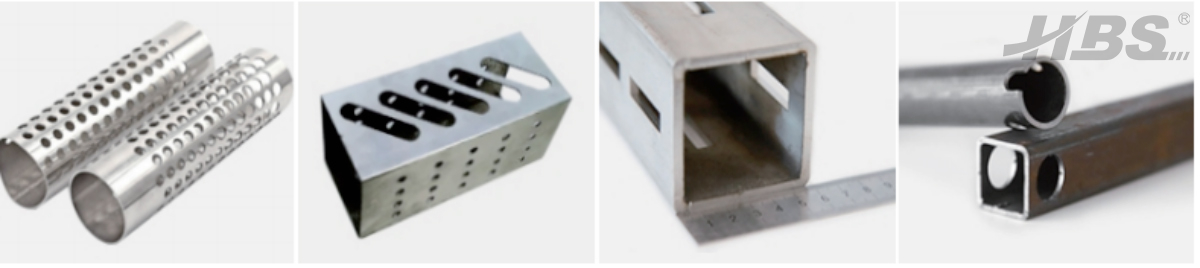
Many hardware frames, furniture components, and structural assemblies are constructed from tubular profiles. To prepare these parts for automated joining, manufacturers must utilize precision cutting technology. Implementing a high-quality metal tube laser cutter ensures that the edges are perfectly straight and immediately weld-ready. This completely eliminates the need for secondary grinding or deburring processes that bottleneck production and introduce dimensional variance.
Specifically, hardware designs frequently incorporate complex interlocking joints. Processes like round tube laser cutting and square tube laser cutting must be executed with extreme precision to create fish-mouth cuts or mortise-and-tenon connections. Precise upstream cutting ensures that when the tubes are clamped in the welding fixture, they mate seamlessly.
To maintain the high throughput capabilities of an automated welding cell, the upstream cutting department must keep pace. Manufacturers operating at scale require a high speed tube cutting machine to feed the welding line continuously. For instance, advanced models can achieve cutting accuracies of ±0.03mm, ensuring every part fits the welding jig perfectly. Conversely, for intricate, miniature hardware components like medical devices or precision sensors, a small diameter tube laser cutting machine serves as the perfect upstream companion. It guarantees micro-level accuracy before the parts ever reach the robotic welding station.
Procuring industrial automation is a capital-intensive decision. Evaluating the machine strictly on its initial purchase price often leads to highly inaccurate financial forecasting. A comprehensive Total Cost of Ownership (TCO) analysis is required to determine the true Return on Investment (ROI).
The upfront cost of an automated laser system is significantly higher than a bank of manual welding stations. However, the payback period is calculated based on labor reduction and exponentially increased output. By transitioning from three manual welders working separate shifts to a single automated cell overseen by one operator, manufacturers drastically reduce payroll, benefits, and liability costs. In addition, the increased throughput allows facilities to take on larger contracts, rapidly accelerating the ROI timeline.
Prospective buyers must evaluate ongoing operational costs. Unlike TIG welding, which consumes tungsten electrodes and expensive shielding gases at a high rate, fiber laser maintenance is relatively low. Nevertheless, you must factor in costs for protective lenses, copper nozzles, and high-purity purging gas (like Nitrogen or Argon).
Furthermore, industrial energy consumption is a major overhead expense. Modern fiber lasers boast a wall-plug efficiency of over 30%, meaning they convert electrical power into laser energy highly efficiently. Compared to legacy YAG lasers or heavy-duty manual arc machines, fiber technology significantly reduces the electrical cost per welded part.
The hardware and software specifications of the machine are only half of the purchasing equation. The reliability of the equipment manufacturer is equally critical. A poorly supported machine can lead to catastrophic downtime, negating the benefits of automation entirely.
Never purchase an industrial laser welder based solely on a PDF brochure. Buyers should demand a Proof of Concept (PoC). Reputable vendors will request samples of your actual hardware parts and specific material grades. They should perform test welds in their applications lab, providing empirical data on cycle times, penetration depths, and tensile strength. This ensures the machine is customized to your exact production reality before capital is deployed.
Transitioning from manual fabrication to CNC-controlled automation requires a shift in workforce skills. Ensure the vendor provides comprehensive, on-site training for your operators and maintenance staff. A machine is only as effective as the operator managing it. More importantly, assess their after-sales support infrastructure. Advanced vendors provide remote diagnostic capabilities, allowing their engineers to log into your machine's controller via a secure network to troubleshoot software issues instantly.
Buying an automatic laser welding machine fundamentally transforms hardware manufacturing operations. To ensure a future-proof investment, facility leaders must evaluate technical specifications strictly from an engineering perspective. Ensure the system possesses the correct beam quality, cooling infrastructure, and automation readiness. Furthermore, recognizing the vital synergy between flawless upstream laser cutting and automated welding guarantees that your production line operates at peak efficiency. Ultimately, the right equipment does not just replace manual labor; it elevates your entire facility's output, consistency, and competitive standing in the global market.
Ready to automate your hardware production line? The key to a successful transition is partnering with experts who understand both precision cutting and automated welding. Explore high-performance, customized industrial solutions at HBS Lasers to find the exact machinery configurations that fit your specific manufacturing needs.
Modern machines are designed with user-friendly interfaces. They utilize intuitive CNC touchscreens and teach-pendants for robotic arms, allowing operators to manually guide the robot to establish a path. Once a successful weld is achieved, the parameters can be saved as a "recipe" for instant recall during future production runs, making changeovers incredibly fast.
While automation replaces the physical act of welding for high-volume, repetitive parts, it rarely eliminates the need for human intelligence. Instead, it allows manufacturers to upskill their existing manual welders into machine operators, automation programmers, and quality control managers, shifting their focus from grueling manual labor to process optimization.
Automated laser welding utilizes a microscopic beam that requires near-zero gap tolerance between parts. If edges are jagged or unevenly cut, the laser beam will pass through the gaps, causing a failed joint. Precision cutting ensures perfect fit-up, which is a mandatory prerequisite for autogenous (no filler wire) laser welding.
The choice of shielding gas depends heavily on the material. For stainless steel and carbon steel, pure Nitrogen or a Nitrogen/Argon mix is typically used to prevent oxidation and maintain a bright, clean weld seam. For welding aluminum or titanium, high-purity Argon or Helium is required to stabilize the weld pool and prevent porosity.
Laser power requirements scale non-linearly with material thickness. As a general engineering guideline, a 1000W-1500W laser is sufficient for sheet metals up to 1.5mm thick. If you are welding 3mm structural hardware, you will typically need a 3000W source to achieve full penetration at a viable production speed. Over-specifying power slightly is recommended to ensure the machine isn't running at 100% capacity constantly, which extends the life of the optical components.
The core component, the fiber laser source, is incredibly durable. High-quality industrial fiber lasers are typically rated for over 100,000 hours of diode life. In a standard production environment, this translates to more than a decade of continuous operation with minimal degradation, provided the optical lenses are kept clean and the cooling system is properly maintained.

