- All
- Product Name
- Product Keyword
- Product Model
- Product Summary
- Product Description
- Multi Field Search


Views: 126 Author: Site Editor Publish Time: 2026-05-05 Origin: Site


Industrial traceability demands absolute precision. Modern manufacturing relies heavily on non-contact, consumable-free processes to permanently alter component surfaces. Light energy provides this ultimate precision, replacing messy inks and damaging physical impact tools. By converting concentrated photons into targeted surface modifications, manufacturers achieve pristine, permanent marks on almost any material.
But choosing the wrong equipment often leads to costly failures. Without understanding exact optical mechanics, you risk burning sensitive parts, warping thin metals, or failing strict compliance audits. Industries bound by FDA Unique Device Identification (UDI) or aerospace traceability mandates cannot afford sloppy marking. If a mark fades or degrades, the entire component becomes a liability.
In this comprehensive guide, we explore the physics behind these powerful tools. You will learn how optical hardware interacts with different substrates and why specific wavelengths matter. We will break down exactly how to match the right machine to your facility's operational goals.
The Optical Path: Marking relies on a synchronized system of laser sources, Q-switches, galvanometers, and F-Theta lenses to concentrate microscopic energy.
Wavelength Dictates Material: Selecting between Fiber, CO2, or a UV laser marking machine depends entirely on the absorption rate and thermal tolerance of the substrate.
Multiple Reaction Types: The machine doesn't just "burn" materials; it can engrave (sublimate), etch (melt), anneal (oxidize), or foam (trap gas), depending on parameter settings.
TCO Advantage: The primary business driver for adoption is the elimination of consumables and mechanical wear, replacing recurring costs with predictable, software-driven precision.
A Laser Marking Machine operates through a highly synchronized chain of optical and electronic events. It does not just shoot a simple beam of light. Instead, it generates, amplifies, pulses, and steers energy with micrometer accuracy.
To understand the hardware, we must first look at the acronym itself. LASER stands for Light Amplification by Stimulated Emission of Radiation. The process begins inside an active medium. For fiber lasers, this medium is often an ytterbium-doped optical fiber. For CO2 lasers, it is a sealed glass tube filled with carbon dioxide gas. Electrical energy excites the atoms within these mediums. When they return to their resting state, they release photons. Mirrors then bounce these photons back and forth, stimulating the release of even more photons to create a concentrated, amplified beam of pure light.
Continuous energy is rarely ideal for marking. You need intense bursts of power to instantly vaporize or melt a surface. This is where the Q-switch comes in. Think of it like crimping a garden hose. Water pressure builds up behind the crimp. When you suddenly release it, you get a brief, powerful blast. The Q-switch acts as an optical gate, holding back the continuous laser energy and releasing it in high-peak-power pulses. These switches operate at blistering speeds, firing anywhere from 1kHz to 70kHz (thousands of times per second). This rapid pulsing prevents excess heat from soaking into the surrounding material.
Once pulsed, the beam needs direction. It enters the galvanometer scanning head, commonly called the galvo. This component houses two ultra-fast, motorized mirrors. One mirror controls the X-axis, and the other controls the Y-axis. They pivot at incredibly high speeds to steer the beam across the target area. Because mirrors carry very little physical mass, they can direct the laser along complex toolpaths at thousands of millimeters per second. This frictionless movement makes galvo systems exponentially faster than traditional gantry-based plotters.
The final piece of optical hardware is the F-Theta lens. A standard lens focuses light onto a curved sphere, which would cause the laser to lose focus at the outer edges of a flat part. The F-Theta lens corrects this geometric distortion. It maintains a consistent, flat focal length across the entire 2D scanning plane. As the beam exits this lens, it compresses into an incredibly dense spot size, often smaller than 40 microns. This intense compression gives the beam its destructive or transformative power.

You cannot use a single laser for every material. Success relies entirely on matching the beam's wavelength to the substrate's absorption profile. If a material reflects the wavelength, nothing happens. If it absorbs the wavelength efficiently, you get a clean mark.
Laser Type | Wavelength | Core Mechanism | Ideal Substrates |
|---|---|---|---|
Fiber | 1064nm | High-heat thermal reaction | Steel, Aluminum, Titanium, Hard Metals |
CO2 | 10,600nm | Thermal vaporization | Wood, Paper, Rubber, Organic Plastics |
UV | 355nm | Photolytic degradation (Cold) | Glass, Silicon, Medical Plastics, Sensitive Electronics |
Fiber technology remains the undisputed industrial standard for hard metals. Operating at 1064nm, these beams are highly absorbed by metals like steel, aluminum, brass, and titanium. The high absorption rate makes it ideal for deep, high-contrast engraving. Manufacturers rely on fiber systems to stamp heavy-duty automotive parts and industrial tools that endure harsh environments. However, this same wavelength passes straight through clear plastics and glass, rendering it useless for those materials.
If your production line handles organic materials, CO2 is the primary solution. At 10,600nm, the wavelength is significantly longer. Materials like wood, cardboard, leather, rubber, and transparent acrylics absorb this long wavelength perfectly. Packaging facilities use CO2 systems to burn expiration dates into cardboard boxes, while bottling plants use them to mark PET plastics. Because it relies heavily on thermal burning, it is generally unsuited for bare metals without specialized pre-treatments.
When heat becomes a liability, manufacturers turn to ultraviolet technology. A UV Laser Marking Machine operates at 355nm, delivering an ultra-short wavelength with immense photon energy. Instead of burning or melting, it utilizes photolytic degradation. It literally breaks the molecular bonds of the material without inducing heavy thermal stress. We call this "cold marking." It is mandatory for highly sensitive electronic components, microchips, glass panes, and medical-grade plastics. In these applications, creating a heat-affected zone (HAZ) is unacceptable because it could warp the micro-structure or introduce micro-fractures.
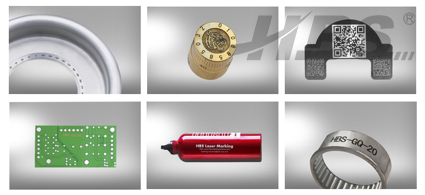
People often use the terms interchangeably, but a laser does not just "burn" things. By adjusting parameters, you dictate exactly how the photons physically alter the surface layer.
Laser Engraving (Sublimation): This is the brute-force approach. Engraving vaporizes the material to create deep, physical cavities. As the beam hits, it instantly pushes the material past its melting point into a gas phase (sublimation). We use this technique for high-wear environments. If a part must survive aggressive post-treatments like sandblasting, powder coating, or e-coating, deep engraving ensures the mark remains legible long after processing.
Laser Etching (Melting): Unlike deep engraving, etching works purely on the top surface. The beam rapidly melts the microscopic surface layer, causing it to expand. As it cools instantly, it alters the surface roughness. This altered texture changes how light reflects off the part, creating a high-contrast mark. Etching is exceptionally fast, making it the go-to choice for high-volume serializing and 2D barcodes on automotive production lines.
Laser Annealing (Oxidation): Annealing is the absolute standard for the medical and food hygiene sectors. Instead of removing material, the laser gently heats the metal sub-surface. This localized heat draws carbon and oxygen molecules upward, creating a distinct, dark oxide layer. The brilliant advantage of annealing is that it leaves the surface perfectly flush. Because it does not disrupt the protective passivation layer, it prevents rust and eliminates microscopic crevices where bacteria might harbor.
Plastics behave very differently than metals under a beam. When marking dark plastics, operators often use a process called Foaming. The beam safely heats the polymer, causing microscopic gas bubbles to form and become trapped under the surface layer. This creates a highly visible, raised white mark. Conversely, for light-colored plastics, we use Carbonization. The high-energy thermal reaction breaks down the polymer chains, turning the localized area dark black for excellent contrast.
Optical hardware is useless without an intelligent brain guiding it. Modern equipment bridges the gap between mechanical engineering and seamless digital software.
Before a beam ever fires, software translates human intent into machine language. Operators import CAD files, complex vector graphics, or simple text into the control interface. For traceability, the software links directly to dynamic databases, automatically generating serialized QR codes or DataMatrix barcodes. The software breaks these designs down into specific "hatch patterns"—a series of tightly packed vector lines that the laser will follow to fill in solid shapes.
The true skill of laser operation lies in parameter optimization. The operator must balance three core variables to force the desired material reaction. Power (measured in wattage) determines the raw thermal energy. Speed (measured in mm/s) dictates how long the beam dwells on any given spot. Frequency (measured in kHz) controls the pulse rate. If you want a deep cut, you increase power, drop the speed, and lower the frequency for aggressive pulses. If you want a delicate surface etch, you increase speed and raise the frequency for smoother, overlapping pulses.
Setting up a new run requires precision. To mitigate alignment errors, modern setups utilize red-light focus diodes. These harmless visible lasers project a bounding box or the exact design outline directly onto the physical part resting on the workspace. Operators use this visual guide to perfectly align the substrate before committing the real beam. This drastically reduces scrap rates during complex short-run batches.
Purchasing the correct setup requires a disciplined approach. Do not buy based on wattage alone. Instead, align the machine's physics with your production floor's reality.
Start by auditing your dominant substrate. If 90% of your production is stainless steel, prioritize a high-wattage fiber unit. If you process sensitive glass or circuit boards, restrict your search exclusively to UV wavelengths. Next, calculate your required throughput per shift. A 20-watt machine might beautifully engrave a steel gear, but it might take 45 seconds per part. Upgrading to a 50-watt unit could slash that cycle time to 12 seconds, justifying the higher upfront cost through labor savings.
Determine how the machine will exist in your facility. Small machine shops often benefit from standalone, manual-load workstations equipped with Class 1 safety enclosures. High-volume manufacturers, however, require inline automated integration. This means sourcing a system that easily communicates with existing PLCs (Programmable Logic Controllers), robotic arms, and conveyor belt sensors to fire precisely as parts pass by.
Never purchase a unit based entirely on a spec sheet. Procurement teams must demand physical material testing from vendors. Send your actual production scraps to the equipment provider. Have them test various parameter windows to confirm the exact cycle times and visual contrast they can achieve. A physical sample provides undeniable proof that the machine's wavelength and wattage match your material.
A laser marking machine is a predictable, physics-driven tool that seamlessly aligns complex optical hardware with specific material properties.
Successful deployment requires moving beyond basic wattage specifications and actively matching the precise wavelength and process type (etching, engraving, annealing) to your facility's exact traceability and compliance goals.
Take action today: Audit your current marking bottlenecks, identify your most problematic substrates, and initiate a material sampling process with a trusted equipment provider to discover the right fit.
A: The primary difference lies in the wavelength and thermal impact. Fiber lasers use a 1064nm wavelength to create high-heat thermal reactions, making them ideal for durable metals. A UV laser marking machine uses a 355nm wavelength for "cold marking." It breaks molecular bonds without inducing heat, perfect for sensitive electronics, glass, and plastics.
A: Depth depends entirely on the material's vaporization point, the laser's power (wattage), and the number of passes. A 50W fiber unit can easily engrave steel to depths of 0.5mm or more by executing multiple, slow passes that continuously sublimate the exposed layers.
A: Yes, provided they have the correct enclosure. Class 1 systems feature fully enclosed cabinets with optical shielding glass, making them entirely safe for open-floor operators without safety glasses. Class 4 systems lack enclosures and require dedicated safety rooms, interlocks, and specialized protective eyewear.
A: Yes. By adjusting the parameters for deep engraving, the machine vaporizes a significant trench into the metal. When the part undergoes powder coating or e-coating, the paint fills the cavity but leaves a visible, tactile indentation, ensuring permanent traceability.


