- All
- Product Name
- Product Keyword
- Product Model
- Product Summary
- Product Description
- Multi Field Search


Views: 157 Author: Site Editor Publish Time: 2026-06-29 Origin: Site


Traceability is no longer just an optional upgrade for manufacturers. It remains a critical mandate across modern industrial shop floors. Implementing reliable, permanent marks on heavy, oversized, or immobile parts presents a serious logistical hurdle. Moving these massive components often bottlenecks production lines entirely. You must deploy the right field marking tool to keep operations flowing smoothly.
Manufacturers typically narrow their options down to two primary contenders for bottom-of-funnel procurement. You can select either a portable dot peen marking machine or a handheld laser marking machine. Deciding between them directly impacts regulatory compliance, overall cycle times, and operator safety.
However, neither technology holds a universal advantage in every scenario. The correct choice depends entirely on specific application variables. You must evaluate substrate hardness, cycle time constraints, and required mark depth. Facility safety capabilities also play a massive role in this decision. This guide will help you navigate these factors objectively to choose the right marking system.
Depth vs. Contrast: Portable dot peen systems deliver superior depth necessary for marks that must survive post-process coating (painting, galvanizing), whereas lasers provide high-contrast, high-resolution marks ideal for machine-readable 2D codes.
Safety & Compliance: Handheld lasers introduce stringent optical safety requirements (Class 4 laser regulations), while dot peen machines present minimal safety risks beyond acoustic noise.
Cost of Ownership: Dot peen technology generally requires a lower initial capital expenditure (CapEx) with minor consumable costs (stylus replacement), whereas portable lasers have higher CapEx but essentially zero consumable costs.
Material Constraints: Lasers offer broader material versatility (metals, plastics, ceramics), while dot peen is strictly mechanically limited to metals and rigid plastics under a specific hardness threshold (typically < 62 HRC).
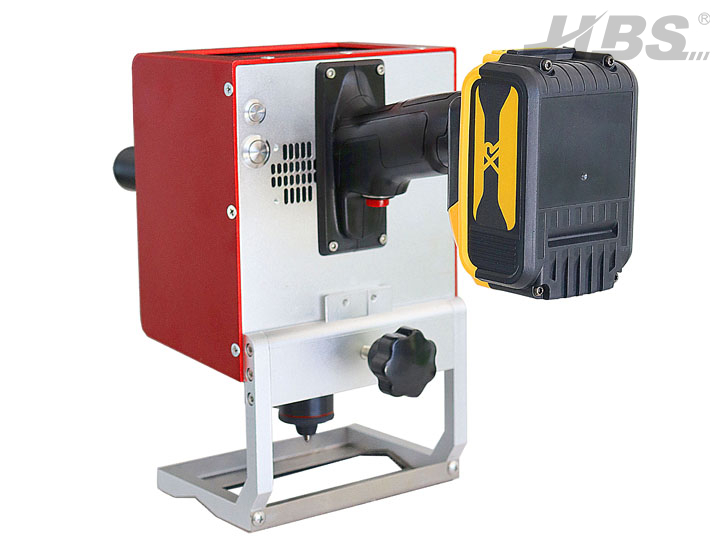
Moving large parts wastes time. It drains operational efficiency. You lose valuable production minutes moving heavy chassis, aerospace components, or oil pipes to a stationary marking station. Forklift traffic increases facility hazards. Staging areas become cluttered with pending inventory. We recommend bringing the tool directly to the part instead. Portable marking equipment eliminates this severe logistical bottleneck. It allows you to serialize components exactly where they sit.
A dot peen marking system utilizes either pneumatic or electromechanical power. It repeatedly drives a hardened carbide or diamond stylus into the substrate. This rapid action displaces the material to form deep micro-craters. It does not remove or burn the material away. This process creates exceptionally low-stress marks. They preserve the structural integrity of the metal. Aerospace and oil industries favor this mechanical displacement for high-stress components.
A laser marking machine operates using a highly focused beam of light. It relies on thermal ablation, surface engraving, or controlled annealing. The process remains entirely non-contact. It creates a localized heat zone that alters the material surface instantly. You never apply any physical force to the fragile component. It excels when you need precision without mechanical impact.
Manufacturers must satisfy strict industrial mandates. Automotive producers require VIN marking. These stamps must remain deep and unalterable. Defense contractors must follow MIL-STD-130 guidelines for permanent UID plates. Aerospace suppliers rely on AS9100 standards for absolute component traceability. You must align your technology choice directly with these regulatory frameworks. Dot peen secures deep structural compliance. Lasers ensure flawless machine-readable precision.
Industrial marks often undergo aggressive post-processing. Parts get painted, heavily galvanized, or intensely sandblasted. A portable dot peen marking machine performs exceptionally well here. It achieves substantially deep impressions. You can reach depths of 0.5mm or greater depending on stylus pressure and material hardness. These deep marks survive thick powder coating layers easily.
Lasers struggle significantly in this specific area. They produce relatively shallow surface engravings. Abrasive post-process environments easily obscure laser marks. Sandblasting will often erase a superficial laser oxide layer completely. You should avoid lasers if your parts face harsh secondary processing.
Production velocity heavily dictates equipment selection. Lasers offer a massive speed advantage over mechanical systems. They mark complex vector logos almost instantly. They generate dense Data Matrix codes in mere milliseconds. Multi-line serial text takes only fractions of a second to complete.
Dot peen systems operate much slower. You can expect realistic cycle times of two to four characters per second. Font size, dot density, and desired depth heavily alter this rate. You must account for this slower throughput when planning continuous assembly line operations.
Machine vision systems track parts across global supply chains. Lasers provide high-definition edge quality. They create extreme optical contrast. Industrial scanners read these dark laser marks effortlessly under almost any lighting condition.
Physical dot peen impressions lack inherent color contrast. You must use specialized lighting configurations to read them. Industrial DPM (Direct Part Mark) barcode scanners require low-angle, multi-axis illumination. This specific lighting highlights the shadows cast by the micro-craters. Reading dot peen codes requires much stricter environmental control.
Feature | Dot Peen Marking | Laser Marking |
|---|---|---|
Max Practical Depth | Deep (Up to 0.5mm+) | Shallow (Typically < 0.1mm) |
Marking Speed | Slow (2-4 characters/sec) | Extremely Fast (Fractions of a sec) |
Visual Contrast | Low (Relies on physical shadows) | High (Thermal oxidation/ablation) |
Post-Process Survival | Excellent (Survives paint/galvanizing) | Poor (Erased by heavy coating) |
Code Readability | Requires specialized DPM scanners | Easily read by standard scanners |
You must navigate strict safety regulations carefully. Open-class handheld lasers introduce severe implementation risks to your facility. They fall firmly under Class 4 laser safety regulations. Stray optical reflections can cause immediate, permanent eye damage to bystanders. You must construct mandatory light-tight safety enclosures. Operators need specialized, wavelength-specific personal protective equipment (PPE). You generally need an officially assigned Laser Safety Officer on site.
Dot peen systems bypass these hazards entirely. They present a remarkably straightforward deployment path. They carry absolutely no optical risks. Your primary safety concern is acoustic noise. Operators might only need standard hearing protection during continuous use. You can deploy them freely across the open shop floor without building isolated safety cells.
Operators frequently carry these tools across expansive outdoor yards. Ergonomics directly influence long-term productivity. You must carefully compare unit weight and battery life. True portability matters immensely for continuous shift use. Heavy handheld laser units often cause severe operator fatigue. They sometimes require thick, cumbersome umbilical cables tethered to a base station.
Modern dot peen machines generally feature highly balanced, lightweight designs. Integrated lithium-ion battery systems eliminate dangerous trip hazards. They give operators complete freedom of movement. You must assess how easily your workers can manipulate the device around complex part geometries.
Manufacturing environments produce metallic dust, thick dirt, and heavy mechanical vibrations. You need equipment that survives these harsh realities. Dot peen machines boast extreme mechanical resilience. Their closed-loop internal mechanics thrive in rugged, dirty environments.
Handheld lasers contain highly sensitive optical lenses. Dirty, airborne particulates degrade laser performance rapidly. Dust settling on the focal lens causes the beam to burn the optic itself. You must clean laser lenses frequently to prevent catastrophic damage. High-vibration environments can also easily misalign delicate internal laser mirrors.
Every industrial tool requires specific, documented maintenance routines. Dot peen machines rely on physical, wear-based consumables. The hardened carbide or diamond stylus eventually wears down. You must replace it periodically to maintain consistent mark depth. The replacement process takes only a few minutes. It requires zero specialized technical training.
Solid-state fiber laser sources function very differently. The core emission source is fundamentally maintenance-free. Manufacturers often rate fiber laser modules for 100,000 hours of continuous operation. However, physical accidents present a major operational risk. If an operator drops the laser head, the internal optics shatter. Replacing these sensitive lenses requires extensive factory recalibration and significant downtime.
Modern traceability relies heavily on accurate, automated data transfer. You must integrate these marking systems with your enterprise software architecture. Most modern facilities utilize ERP or MES platforms for automated part serialization.
Both technologies offer robust integration ecosystems. Modern controllers process dynamic serial numbers, shift codes, and date strings automatically. You can prevent costly duplicate marks through centralized database control. Look for machines offering seamless Wi-Fi, Bluetooth, or PROFINET connectivity. This ensures your field operators always pull the correct marking data directly from your central servers.
Your parts will undergo aggressive post-processing like wet painting, hot-dip galvanizing, or shot peening.
Permanent, deep structural traceability is legally mandated by automotive or heavy-industry standards (e.g., VIN stamping).
The primary operational environment is rugged, outdoor, highly contaminated, or prone to heavy vibrations.
Avoiding strict Class 4 laser safety compliance protocols is a high priority for your facility management team.
Operators need to mark extremely heavy components that cannot easily be moved into an enclosed safety cell.
You require high-resolution, high-contrast, or highly dense UID and Data Matrix codes for immediate scanning.
You need to mark non-metals like rigid plastics, polymers, or composites alongside your standard metal parts.
Your required production velocity demands extremely short cycle times measured in mere fractions of a second.
The component is highly fragile, thin-walled, or easily deformed by physical impact.
You want to eliminate the maintenance task of routinely replacing worn mechanical stylus pins.
Selecting the right marking equipment comes down to understanding one fundamental trade-off. You must balance the need for deep, rugged mechanical impact against rapid, high-contrast optical ablation. Dot peen technology guarantees your marks survive the harshest post-processing environments. Laser technology delivers unmatched speed and incredible aesthetic precision.
Your production environment, post-mark processing steps, and facility safety infrastructure should dictate your final procurement decision. Do not rely on spec sheets alone. We strongly recommend initiating a rigorous sample testing phase. Send your specific substrate materials to your chosen vendor. Objectively measure the resulting depth, vision system readability, and true cycle time before finalizing your equipment purchase.
A: A dot peen system achieves significant depth, ranging from 0.1mm up to 0.5mm or more. This depth depends heavily on pneumatic pressure and substrate hardness. Lasers generally achieve very shallow marks, typically less than 0.1mm efficiently. Achieving deeper engravings with a portable laser requires multiple slow passes, severely bottlenecking production.
A: They are not safe for open use without strict precautions. Handheld open-beam lasers are Class 4 devices. They require stringent OSHA and FDA compliance. You must use specialized light-tight enclosures. Operators and bystanders must wear wavelength-specific safety glasses to prevent permanent retinal damage from scattered reflections.
A: Yes, they can absolutely create 2D codes. However, reading them requires specific conditions. You must ensure precise dot spacing during setup. You also need specialized DPM (Direct Part Mark) barcode scanners equipped with low-angle illumination to read the physical shadows of the micro-craters successfully.
A: Dot peen systems face strict mechanical limitations based on material hardness. They typically top out at around 60 to 62 HRC (Rockwell Hardness Scale). If you need to mark ultra-hardened tool steels, aerospace titanium alloys, or solid carbides, you should utilize a laser marking machine instead.

