- All
- Product Name
- Product Keyword
- Product Model
- Product Summary
- Product Description
- Multi Field Search


Views: 0 Author: Site Editor Publish Time: 2026-07-06 Origin: Site


Industrial part marking requires balancing mobility, marking depth, and infrastructure limitations. Plant managers often face a choice between tethered air-driven power and untethered electric agility. Choosing the wrong equipment can lead to production bottlenecks, shallow marks, or severe workflow disruptions.
We are witnessing a core shift from traditional compressed-air systems to modern, highly mobile electric alternatives. Historically, heavy fabrication relied entirely on fixed workstations. Today, engineering teams demand tools they can carry directly to oversized components. This shift forces you to reevaluate how you integrate marking technologies into your daily operations.
This guide provides an objective, engineering-focused comparison to help buyers select the right system based on operational constraints. We will explore mechanical differences, performance outputs, and practical agility. You will learn how to evaluate these systems so you can make an informed purchasing decision tailored to your unique production environment.
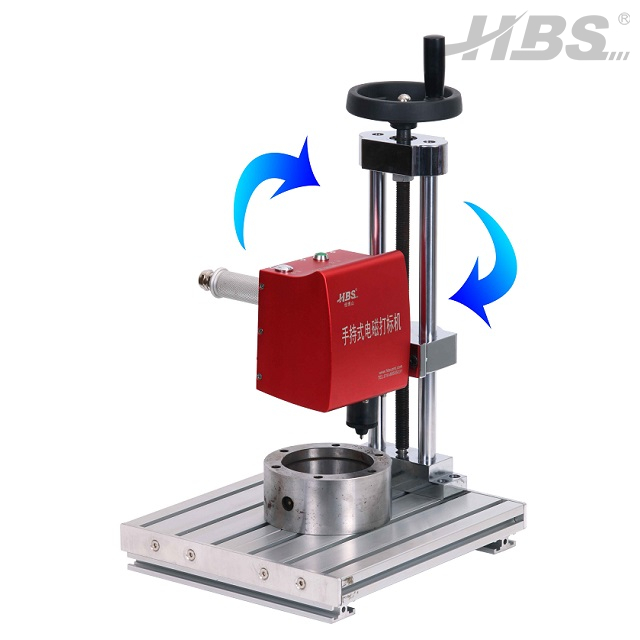
Understanding the fundamental mechanics behind these two systems helps you predict how they will behave on your shop floor. Each technology uses a completely different method to drive the carbide pin into the metal surface.
A traditional pneumatic marking machine relies heavily on external air pressure. Compressed air travels through hoses and valves to drive the marking pin up and down. Most industrial units require a stable pressure ranging from 60 to 90 PSI (4 to 6 Bar).
This setup demands robust infrastructure. You need dedicated air lines, moisture regulators, and stationary workstations. The system must maintain consistent pressure to ensure uniform marking depth. Any fluctuation in your plant's air compressor directly affects the final mark quality. To successfully deploy this technology, you typically need the following infrastructure components:
Modern electric systems abandon air pressure entirely. An electric dot peen marking machine uses an internal electromagnetic coil. When an electrical current pulses through this coil, it rapidly propels the stylus forward. High-capacity lithium-ion batteries power this entire process.
This engineering approach shifts the energy source from an external compressor to an onboard power cell. The digital controller regulates the electrical pulses, offering precise control over the pin's striking force. Because the system runs strictly on electricity, it operates independently of your facility's central utilities.
The physical footprint of these two systems differs drastically. Pneumatic setups consume significant floor space. They tie you to specific zones where air drops are available. You also deal with the hidden complexities of managing compressor energy loads and chasing down minor air leaks across your facility.
Battery systems simplify your floor plan. They require zero external connections during operation. You only need a standard wall outlet to dock and charge the spare batteries. This straightforward charging requirement minimizes setup time and completely eliminates the need to route permanent utility lines across your workspace.
Mechanical differences directly influence how each machine performs on various metals. You must evaluate raw marking depth, cycle times, and material hardness limits before committing to a specific technology.
Pneumatics consistently win in applications demanding extreme raw depth. Heavy industrial environments often require deep structural steel marking before components undergo galvanization or thick powder coating. Compressed air delivers massive impact force, displacing enough metal to ensure the characters remain legible even after layers of protective coating are applied.
Conversely, a battery powered dot pin marking machine offers excellent capabilities for standard fabrication. These units easily mark aluminum, structural steel, brass, and industrial plastics. They typically handle material hardness up to HRC 60. While they may not punch as deeply as air-driven models, they provide more than enough depth for standard traceability, serial numbers, and 2D DataMatrix codes on uncoated or lightly coated parts.
Cycle time directly impacts your production throughput. Pneumatic models often hold a slight edge in aggressive, high-speed deep marking applications. The rapid mechanical return of the air cylinder allows the pin to strike at incredibly high frequencies.
However, electric systems excel in precision. The digital force control manages the electromagnetic coil with exact timing. This creates smoother, highly precise micro-dot alignments. If you need high-resolution aerospace parts marked or require perfectly readable QR codes for automated optical scanners, the controlled strike of an electric unit often yields superior edge clarity.
You must approach equipment capabilities realistically. Battery-powered units should never be oversold for deep-penetration requirements on ultra-hard materials like cast iron or aerospace-grade titanium, especially if those parts receive thick post-mark coatings.
If you apply a thick epoxy paint over a battery-struck mark on cast iron, you risk losing legibility. Always match the machine's impact force to your specific post-processing requirements. We recommend testing your actual materials to confirm the depth meets your industry compliance standards.
The physical environment where you mark your parts dictates which system will succeed. You must consider operator movement, part size, and overall shop floor safety.
Sometimes bringing the part to the machine is physically impossible. You need the mobility advantage when marking heavy machinery, oil and gas pipelines, massive structural beams, or materials stored out in inventory yards.
Battery technology shines in these scenarios. Operators can grab the tool, walk across a five-acre laydown yard, and mark a steel I-beam instantly. There are no limits on distance. The machine travels exactly where the work happens, drastically reducing material handling time and eliminating the need for overhead cranes simply to mark a serial number.
Real-world shop floor feedback frequently highlights the frustrations of tethered tools. Air hoses create severe tripping hazards. Dragging heavy pneumatic lines across a cluttered workspace increases operator fatigue and raises safety liabilities. Furthermore, the constant hissing of air valves and the distant rumble of compressors contribute to hazardous noise levels.
Untethered battery tools resolve many of these ergonomic pain points. They offer operators total freedom of movement. Without dragging a rigid hose, workers can easily manipulate the marker to stamp angled surfaces or hard-to-reach chassis components. This freedom directly translates to fewer workplace injuries and higher daily productivity.
Despite the benefits of mobility, pneumatic systems remain the absolute standard for automated environments. If you operate robotic cells or fixed-station assembly lines, parts consistently flow to the machine. In these highly controlled setups, mobility is entirely irrelevant.
A mounted air-driven unit integrates seamlessly into PLC-controlled manufacturing lines. They run continuously for multiple shifts without needing battery swaps. For stationary, high-volume production, the raw power and indefinite runtime of a fixed pneumatic station cannot be matched.
| Operational Feature | Pneumatic Marking Systems | Battery-Powered Systems |
|---|---|---|
| Range of Motion | Limited by air hose length (typically 5 to 10 meters). | Unlimited; operator can walk anywhere. |
| Safety Hazards | Tripping risks from hoses; high noise levels. | Zero trip hazards; generally quieter operation. |
| Ideal Environment | Automated cells, fixed assembly lines. | Field operations, large assembly yards. |
| Continuous Run Time | Infinite (as long as air pressure remains stable). | Limited by battery capacity (requires swapping). |
Choosing the correct equipment requires a logical evaluation of your facility. You must align the machine's capabilities with your daily workflow. Use this framework to guide your decision-making process.
Review the scenarios below to see where your operations fit best.
Before issuing a purchase order, systematically audit your current operations. Follow these steps to ensure you select the appropriate technology:
Selecting the ideal industrial marking tool requires a clear understanding of your specific production environment. Neither technology is universally superior. The correct choice hinges entirely on your parts' mobility and your required mark depth.
Battery-powered systems provide unparalleled agility, making them perfect for massive parts and outdoor field operations. Air-driven systems deliver the raw power needed for heavy industrial coatings and continuous automated assembly lines. You must weigh the freedom of an untethered tool against the deep-striking permanence of compressed air.
We strongly recommend requesting sample marks on your actual materials before finalizing any equipment upgrades. Verify the depth and legibility firsthand. Direct your engineers to contact technical support for a detailed consultation, request a custom sample marking video, or review the comprehensive technical spec sheets for both equipment categories.
A: Most industrial units provide 4 to 8 hours of continuous working time, depending on the marking depth and frequency. Standby time often extends up to 12 hours. We highly recommend purchasing dual hot-swappable batteries. This ensures zero downtime, as one battery charges while the operator uses the other.
A: Yes, they easily mark stainless steel, standard steel, and brass. They are generally rated for metals up to HRC 60. While they create highly legible, precise marks on hard metals, they typically will not achieve the extreme raw depth a pneumatic system can provide on those same materials.
A: They do not require highly specialized compressors, but they do require stable shop air. You need a system capable of delivering a consistent 60 to 90 PSI (4-6 Bar). You must also install oil and water separators to prevent moisture from destroying the internal pneumatic cylinders and valves.
A: Battery systems generally score higher for shop floor safety. They completely eliminate tripping hazards caused by trailing air hoses and reduce ambient noise. However, buyers must evaluate machine weight; some battery units are heavier due to onboard controllers, potentially causing operator wrist fatigue during extended overhead use.

